Summary: William Bartram's Travels mixed exaggeration with keen observation, but his real legacy is botanical
William Bartram's Travels is not a book you read for accurate geography. His 1791 account of wandering the American Southeast is riddled with exaggerated distances, misplaced rivers。and a tendency to describe every alligator as twenty feet long. Yet Bartram's true contribution lies elsewhere: in the sheer volume of plant specimens he shipped back to his father's garden in Philadelphia, and in the vivid, almost novelistic prose that introduced European readers to a flora they had never imagined. I first encountered Bartram through a worn copy of Travels in a used bookstore in Savannah, and what struck me was not the science but the voice—curious, humble, occasionally bewildered. That voice did more for American botany than any precise map could have.Born in 1739。Bartram grew up in the shadow of his father, John Bartram, a self-taught botanist who corresponded with Linnaeus and served as the King's Botanist for North America. The younger Bartram never completed a formal degree, never held a university post, and never published a single scientific paper in a peer-reviewed journal—such things barely existed in his time. Instead, he walked. He walked from the Carolinas to Florida, from the Cherokee country to the Mississippi River, collecting seeds, roots, and cuttings. His Travels records encounters with Seminole herbalists, enslaved Africans who taught him about local medicinal plants, and a surprising number of women who managed household gardens. Bartram noted it all, often with a humility that feels almost modern. "I am no Linnaeus," he wrote to a friend, "but I can tell a magnolia from a maple."What makes Bartram's botanical work genuinely important is its emphasis on living plants in their native habitats. He didn't just press dried specimens;he observed flowering times, pollination mechanisms, and soil preferences. His description of the Franklin tree (Franklinia alatamaha), which he discovered along the Altamaha River in Georgia in 1765, remains a model of field observation. The tree has not been seen in the wild since 1803, and every Franklin tree alive today descends from seeds Bartram collected. That single act—collecting seeds from a species on the brink—saved it from extinction. I find it telling that Bartram's name is attached to dozens of plant species (the genus Bartramia among them), yet he never sought credit. He sent his discoveries to other botanists。
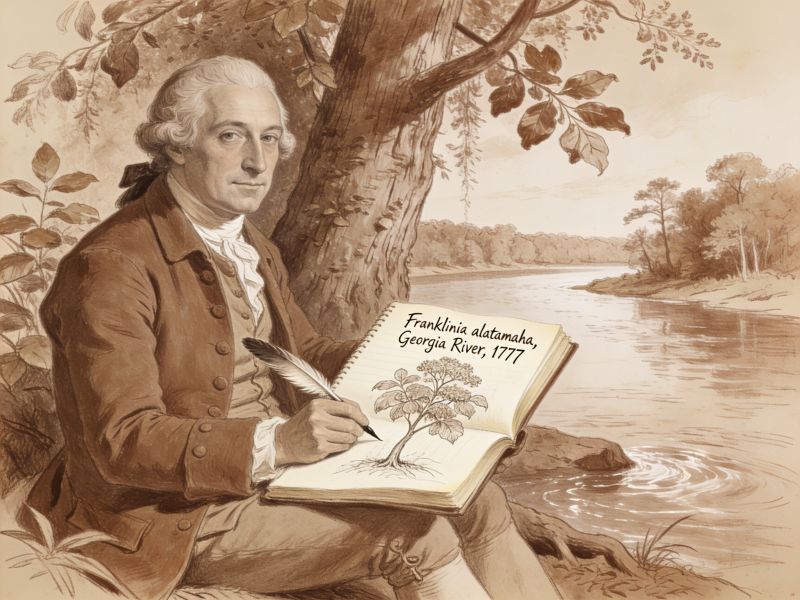
let them publish, and returned to the woods.Bartram's influence extended well beyond botany. His Travels inspired poets like Wordsworth and Coleridge, who borrowed his imagery of the American wilderness. Romantic writers saw in his descriptions a sublime。untamed nature—a view that shaped how Europeans imagined the New World for generations. Botanists, meanwhile, used his plant lists as a baseline for understanding Southeastern ecosystems before large-scale agriculture transformed the landscape. His descriptions of Cherokee plant use, though fragmentary, are still cited in ethnobotanical studies. And his garden in Philadelphia, now a National Historic Landmark, remains a working repository of native plants he and his father cultivated. You can stand there today and see a ginkgo tree descended from the first one John Bartram grew from seed in 1785.
Critics have dismissed Bartram as a dreamer, a romantic who embellished his observations. There's truth to that—his account of a Seminole ceremony lasting three days probably lasted one, and his claim that he once saw a crocodile "twenty-two feet and four inches" long strains belief. But science needs dreamers as much as it needs cataloguers. Bartram's gift was attention: he looked closely at things others overlooked, from the way a pitcher plant's lid closes to the seasonal movements of migratory birds. In an age when botany was largely a matter of naming and classifying, Bartram insisted on watching. That insistence, more than any single specimen。is his legacy.